
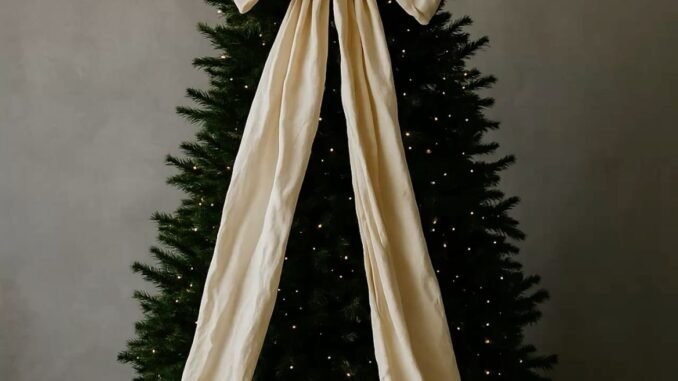
Bows on Christmas Trees
There is something instantly cheerful about a Christmas tree dressed in bows. Long before the ornaments go on and the lights start to twinkle, a simple loop of ribbon can change the whole feeling of a room. Bows are soft where baubles are hard, and they add movement and texture that flat decorations cannot match. This year, trees covered in bows are everywhere, from grand living rooms to tiny apartment corners, and it is easy to see why. A bow costs very little, takes only a minute to tie, and can be moved, swapped, or added to until the tree looks exactly right. Whether you love a classic red velvet look or a pale, dreamy tree in white and blush, bows give you a way to decorate with confidence, even if you have never styled a tree before.
Why Bows Are Back on Christmas Trees
Bows have decorated Christmas trees for generations, but they disappeared for a while behind glittering bauble sets and themed ornament collections. Now they are back, and the reason is simple: people want trees that feel warm and handmade rather than perfect and store-bought. A bow looks like someone took the time to make it, even when it came from a spool of ribbon. It softens the stiff shape of an artificial tree and gives a real tree a finished, intentional look. Social media has helped too, with bow-covered trees filling feeds every December and inspiring decorators to try the look at home.
Another reason for the comeback is flexibility. You can build an entire tree theme around bows, or use just a handful to fill gaps between ornaments. If you change your mind halfway through decorating, bows are easy to move. They do not break, they do not need hooks, and they work on every branch, thick or thin. For families decorating together, bows are also wonderfully forgiving: a slightly lopsided bow still looks charming, which makes them a perfect job for children and first-time decorators alike.

Choosing the Right Ribbon Width
Ribbon width makes a bigger difference than most people expect. A narrow ribbon, around one inch wide, creates a delicate, dainty bow that suits small trees and trees that already carry a lot of ornaments. A medium width of about two inches is the all-rounder, visible from across the room without overwhelming the branches. Wide ribbon, three inches or more, makes a bold statement bow that can anchor a whole tree design, especially when used as a topper or spaced generously down the tree.
As a rule, match the ribbon to the size of your tree. A seven-foot tree can handle wide, dramatic bows, while a four-foot tree looks best with narrower ones. Also think about the branch density: on a slim tree, wide bows can hide the greenery, while on a full tree they sit proudly on the surface. Buy one spool first and test a few bows on your tree before committing to a whole roll. Seeing the ribbon against your own branches is worth more than any shopping guide.

Velvet Bows for a Luxurious Look
Nothing says luxury quite like velvet. Velvet ribbon has a soft, matte surface that catches light gently instead of shining, which gives a tree a rich, expensive feeling even on a modest budget. Deep colors like burgundy, forest green, and navy look especially beautiful in velvet, and the fabric holds its shape well once tied. If you want a tree that looks like it belongs in a boutique hotel lobby, velvet bows are the fastest route there.
Velvet works best when you let it be the star. Pair velvet bows with simple ornaments in gold, silver, or glass, and keep the rest of the palette calm. Too many competing textures can make the tree look busy, so resist adding glitter garlands and patterned baubles on top of velvet. A few velvet bows, warm white lights, and a scattering of plain ornaments will give you a tree that feels elegant from the doorway and cozy up close.

Classic Red Bows That Never Fail
Red bows are the original Christmas tree bow, and they have never really gone out of style. Red reads instantly as festive, it photographs beautifully, and it pairs with almost any other color you already own, from gold and silver to green and white. A tree dressed only in red bows, warm lights, and a few silver baubles looks timeless rather than dated, which is why so many families return to red year after year.
The trick with red is choosing the right shade. A bright cherry red feels playful and modern, while a deep burgundy or wine red feels traditional and grown-up. If your room already has a lot of red, such as a red rug or curtains, a deeper shade will blend more gracefully. If your room is mostly neutral, a brighter red will add the pop of color the space needs. Either way, keep your reds consistent: mixing three different reds can look accidental, while one repeated shade looks deliberate.

White and Ivory Bows for a Soft Glow
White and ivory bows create the softest, dreamiest version of the bow tree. They reflect the Christmas lights beautifully, making the whole tree seem to glow from within, and they suit rooms that already feel light and calm. On a green tree, white bows stand out crisply, like fresh snow on branches. On a flocked or white tree, they blend into a gentle winter wonderland effect that feels peaceful rather than plain.
Because white shows every mark, choose a fabric that holds up well, such as satin or grosgrain, and keep spare bows ready in case one gets dusty in storage. White bows also pair beautifully with metallic ornaments: gold adds warmth, silver adds cool sparkle, and a mix of both keeps things interesting. If an all-white tree feels too pale for your taste, add a few natural touches like pinecones or wooden ornaments to ground the look.

Pink Bows for a Playful Tree
Pink bows are for decorators who want Christmas to feel fun. Blush pink feels romantic and soft, hot pink feels bold and joyful, and a mix of pink shades with white ornaments creates a candy-like tree that children adore. Pink works surprisingly well with traditional green, and it is a lovely choice for a bedroom tree, a girls room tree, or any space where you want the holidays to feel a little less formal.
To keep a pink tree from looking like a birthday party, anchor it with a few grown-up touches. Warm white lights instead of colored ones, a simple tree skirt, and a few glass or silver ornaments will keep the look festive rather than frilly. You can also limit pink to the bows alone, keeping ornaments neutral, so the tree reads as a deliberate design choice. Pink bows are also a great way to reuse a tree that feels tired: a new ribbon color can make the same old ornaments look brand new.

How Many Bows Does a Tree Need
One of the most common questions is simply how many bows to buy. A good starting point is about twelve bows for a six-foot tree if bows are your main decoration, and about twenty if you want a full, bow-covered look. For a tree that also carries many ornaments, eight to twelve bows scattered evenly will add charm without crowding. These are only guides, though: the right number depends on how full your tree is and how large your bows are.
Start with fewer than you think you need and step back often. It is much easier to add bows than to remove a tree that has become a wall of ribbon. Place your first bows at the top, middle, and bottom, then fill the gaps so the spacing feels even from every angle. Walk around the tree, not just in front of it, because guests will see the sides too. When the tree looks balanced from the doorway and the sofa, you have enough.

The Oversized Bow Topper
An oversized bow topper is the single most dramatic thing you can do with ribbon. Instead of a star or angel, a huge bow sits at the crown of the tree with long tails cascading down the branches. It draws the eye upward, makes the tree look taller, and sets the whole theme in one gesture. This look works best on trees with a strong, straight top that can support the weight of the bow without bending.
To make a topper bow, use wide, wired ribbon so the loops hold their shape, and secure it firmly to the top branches with floral wire. Let the tails fall naturally and tuck them gently into the branches. If a giant bow feels too much, a medium bow topper with shorter tails gives the same effect in a softer way.

Scattering Small Bows Through the Branches
Small bows scattered through the branches create a completely different effect from one big topper. Instead of a single focal point, the eye travels all over the tree, discovering little surprises at every level. This style suits trees that already have ornaments, because small bows fill the gaps between baubles and make the tree look fuller without adding weight. It is also the easiest bow style to achieve, since small bows tie quickly and forgive mistakes.
For the best effect, use bows in one or two colors and keep the sizes similar. Random sizes can look messy, while a repeated small bow reads as a pattern. Attach each bow to a branch tip with a short piece of wire or a twist tie, and angle some bows outward and some sideways for a natural feel. Step back after every five or six bows to check the spacing, and remember that the back of the tree needs a few bows too, even if guests rarely see it.

Mixing Bow Colors Without Clutter
Mixing bow colors can be beautiful, but it needs a plan. The safest approach is to choose one main color and one accent: red with gold, navy with silver, or blush with white. Use the main color for about two-thirds of your bows and the accent for the rest, so the tree still reads as one design. A third color can work if it appears in small amounts, such as a few metallic bows among a red and white scheme.
Avoid mixing warm and cool tones without thinking. Warm reds and golds sit happily together, and cool blues and silvers do too, but throwing all four together can make the tree look confused. If you love many colors, tie them together with a neutral: white or cream bows scattered throughout will calm a rainbow of ribbons. Finally, check your bow colors against your room. A tree should complement the space around it, not fight with the sofa, curtains, and wrapping paper.

Bows on a Flocked Tree
Flocked trees, with their snowy white branches, are a natural partner for bows. The white flocking acts like a blank canvas, so almost any ribbon color pops, and the soft texture of flocking pairs beautifully with velvet and satin. Red bows on a flocked tree look like a classic Christmas card, while pastel bows create a soft winter scene. Because flocking already adds visual texture, you can use fewer ornaments and let the bows carry the design.
One practical tip: flocking sheds a little, so attach bows with wire rather than adhesive, and avoid pressing ribbon deep into the branches where flocking can stick to it. Place bows on the outer tips where they stay clean and visible. If your flocked tree lives in a high-traffic spot, choose darker ribbon colors that will not show dust as quickly. A flocked bow tree also needs less lighting than a green tree, since the white branches already reflect light well.

Bows and Ornaments: Getting the Balance Right
Bows and ornaments can share a tree happily, but they need balance. If your ornaments are large and colorful, use smaller, simpler bows so the tree does not feel crowded. If your ornaments are small and plain, larger bows can take center stage and give the tree its personality. Think of bows as the fabric of the tree and ornaments as the jewelry: both are lovely, but one should lead.
A practical method is to decorate in layers. Put the lights on first, then the bows, then the ornaments. This way you can see where the bows sit before you fill the remaining spaces with baubles. Leave some branches bare too: a tree that is completely covered can look heavy, while a few gaps let the greenery breathe and make the decorations stand out. Stand back at each stage and trust your eye more than any rule.

Tying the Perfect Bow by Hand
A beautiful hand-tied bow is easier than it looks. Cut a generous length of ribbon, form two loops like bunny ears, cross them, and pull one loop through the gap, just like tying shoelaces. Then adjust the loops until they are even, pull the tails to the length you want, and trim the ends at an angle for a finished look. Wired ribbon makes this much easier, because the wire holds the loops open while you work.
Practice with scrap ribbon before cutting into your good spool, and make all your bows at a table rather than up a ladder. It is faster to tie twenty bows sitting down, then carry them to the tree, than to tie each one in place. If your loops keep collapsing, your ribbon may be too soft: switch to a wired or stiffer ribbon, or add a small stitch through the center knot to hold everything in place. Imperfect bows still look charming on a tree, so do not chase perfection.

Using Wire-Edged Ribbon for Shape
Wire-edged ribbon is the secret weapon of bow trees. A thin wire runs along each edge of the ribbon, letting you bend, fluff, and shape the loops exactly how you want them, and they stay put. This is especially useful for large bows and toppers, where soft ribbon would flop flat. Wire-edged ribbon also survives storage better, since you can reshape it next year instead of starting over.
When working with wire-edged ribbon, be gentle with the ends: the wire can poke out after trimming, so fold the cut edge under or cover it with a small piece of tape. Also keep wire-edged bows away from very young children, since the wire ends can be sharp. For a softer look, you can use wire-edged ribbon for the structure and layer a soft ribbon on top. The combination gives you shape and softness in one bow.

Bows for Small Trees and Tabletop Trees
Small trees deserve bows too, and they may benefit even more than large ones. A tabletop tree can look bare with just a few ornaments, but five or six small bows instantly make it feel dressed and intentional. Choose narrow ribbon for small trees, around one inch wide, and keep the bows simple: a classic two-loop bow reads better at small scale than a complicated layered bow.
On a small tree, placement matters even more, because every bow is visible. Put one bow near the top, two in the middle, and two near the bottom, and check the tree from all sides. If you have several small trees, use the same ribbon on all of them for a coordinated look.

A Bow Theme for the Whole Room
Once your tree looks wonderful, why stop there? Bows can tie a whole room together. Use the same ribbon on wreaths, garlands, stair railings, and gift wrapping, and the room will feel designed rather than decorated in pieces. A consistent ribbon is one of the cheapest ways to make a home look polished for the holidays, because a single spool can stretch across many projects.
Start with the tree, then carry the ribbon outward. A bow on the mantel wreath, a few bows along the staircase, and matching bows on presents under the tree will echo the theme without much extra work. Keep the ribbon the same color and fabric throughout for the strongest effect. If you run low, use the leftover ribbon for small touches like napkin ties at Christmas dinner, which guests always notice.

Keeping Bows Safe Around Kids and Pets
Bows are generally safer than glass ornaments, but they still need a little care around children and pets. Attach bows firmly with wire so curious hands and paws cannot pull them off easily, and avoid very long tails at toddler height, since dangling ribbon invites tugging. If you have a cat that loves ribbon, keep an eye on the lowest branches, and remove any bow that comes loose before it becomes a toy.
Choose fabrics that are safe if chewed or pulled: soft ribbon without wire is best for the lowest branches of a family tree, while wired bows can live higher up where little hands cannot reach. Also skip bows with small attached decorations like bells or beads on a tree that toddlers can reach. A bow tree can be both beautiful and family-friendly with a little planning, and children will love helping to tie the bows they are allowed to touch.

Storing Ribbon Bows for Next Year
Good bows deserve a second Christmas. To store them, remove each bow gently and place it in a box lined with tissue paper, keeping bows in a single layer so they do not crush each other. Stuff the loops lightly with tissue to hold their shape, and keep the box in a cool, dry place away from sunlight, which fades ribbon over time. Label the box with the ribbon color so you can find it next December.
Wired bows store especially well, since you can reshape them after unpacking. Soft bows may need a quick steam or a light press with a cool iron to remove creases. If a bow has lost its shape completely, do not throw it away: untie it and reuse the ribbon for gift wrapping or a fresh bow. Ribbon is forgiving, and a little care in January saves money and shopping time next November.

Budget-Friendly Bow Ideas
A bow tree is one of the most affordable ways to decorate for Christmas. A single spool of ribbon can make ten to twenty bows, and discount stores, craft shops, and online sellers all carry beautiful ribbon at low prices. Watch for sales after Christmas too: ribbon bought in January at a deep discount will be ready for next year, and classic colors like red, gold, and white never go out of style.
You can also make bows from fabric scraps or old scarves. Another trick is to buy one high-quality spool in your main color and a cheaper spool in an accent color, rather than many expensive spools. And remember that bows let you reuse old ornaments: a fresh ribbon color makes last year’s baubles feel new.

A Simple Bow Tree You Can Finish Tonight
If you want a beautiful tree without a weekend project, here is the simplest plan. Start with warm white lights, then tie twelve bows in one color of medium-width ribbon. Place one bow at the top, then work down the tree in a spiral, spacing the bows evenly. Add a few plain ornaments if you have them, or skip ornaments entirely: a tree of lights and bows alone looks clean, modern, and intentional.
Finish with a simple tree skirt and step back. You will be surprised how complete the tree looks with so little effort, and you can always add more bows over the following days. The beauty of a bow tree is that it is never really finished until you say it is.

However you use them, bows bring a softness and warmth to Christmas decorating that few other decorations can match. They are affordable, forgiving, and endlessly adaptable, from a single elegant topper to a tree covered from top to bottom. Start with one spool, tie a few bows, and see how your tree responds. Chances are, your bow tree will become a tradition your family looks forward to every year.
Leave a Reply