
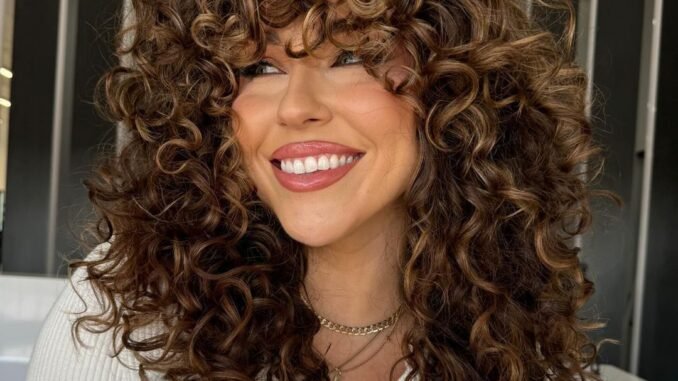
Few haircuts have earned a devoted following the way the butterfly cut has, and when it meets naturally curly hair, something special happens. Curly Butterfly Cuts take the layered, face-framing shape that went viral on straight hair and adapt it for texture, giving curls bounce, movement, and shape without sacrificing length. The result is a cut that looks full and intentional from every angle, with shorter layers around the face that flutter like butterfly wings and longer layers through the back that keep your length.
If you have been growing your curls out and feeling stuck in one shapeless mass, this cut might be the reset you need. In this guide, we explain exactly what a butterfly cut is, why it works so beautifully on curly hair, what to ask for at the salon, and how to style and maintain it at home, with inspiration for short, medium, and long lengths.
What Is a Butterfly Cut?
The butterfly cut is a heavily layered haircut defined by two distinct layer lengths: short, face-framing layers around the front that typically fall between the chin and collarbone, and much longer layers through the back. The contrast between the two creates the illusion of a shorter haircut from the front and long hair from the back, like a butterfly with its wings open. It first went viral as a 90s-inspired blowout look, but stylists quickly realized the architecture works for texture too.
On curly hair, the butterfly cut is less about a sleek blowout and more about strategic weight removal. The short front layers spring up into bouncy face-framing curls, while the long back layers keep length and prevent the dreaded triangle shape. It is a cut that works with your curl pattern instead of against it, which is why curly clients who try it rarely go back to one-length hair.

Why the Butterfly Cut Works So Well on Curly Hair
Curly hair has a volume problem that straight hair does not: without layers, the weight of the hair pulls the top flat while the ends expand outward, creating a pyramid effect. The butterfly cut solves this by removing weight exactly where it causes trouble. The shorter crown and face-framing layers release the top, allowing curls to spring up and create lift at the roots, while the longer layers underneath support the shape.
The cut also enhances curl definition. When curls are all one length, they clump into heavy sections that hide the pattern. Varied layer lengths let individual curl clumps separate and coil freely, which reads as more defined, bouncier texture. Many curly clients report that their wash-and-go results improve dramatically after a butterfly cut, simply because the hair can finally move the way it wants to.

The Difference Between a Butterfly Cut and Regular Layers
All butterfly cuts are layered, but not all layered cuts are butterfly cuts. Traditional long layers blend gradually from front to back with relatively small differences in length. A butterfly cut is deliberately dramatic: the shortest front layers may be six or more inches shorter than the longest back layers, creating two visible tiers. That disconnect is the signature of the style.
On curly hair, this matters because shrinkage exaggerates length differences. A stylist experienced with curls will account for how much each curl type springs up when dry, cutting the front layers slightly longer than the target so they land correctly. If you ask for generic layers, you will get a blended, safe result. If you ask for a butterfly cut, you get the bold, face-framing shape that makes the style recognizable.

Face Shapes That Suit Curly Butterfly Cuts
The butterfly cut is unusually adaptable across face shapes because the face-framing layers can be customized. Round faces benefit from longer front layers that start at or below the chin, which elongate the face. Oval faces can handle almost any variation, including shorter, bouncier framing. Square faces are softened by curved, cheekbone-skimming layers that break up strong angles.
Heart-shaped faces look best with volume through the lower layers to balance a narrower chin, which the butterfly’s long back layers provide naturally. The key conversation with your stylist is where the shortest layer should fall. Bring reference photos of people with a similar face shape to yours, and be honest about how much daily styling you will do; the cut should flatter you on air-dry days too, not just fresh from the salon.

Curl Types: From Waves to Coils
The butterfly cut works across the curl spectrum, but the execution changes with texture. Loose waves (2A to 2C) get the most visible wing effect, since the layers create soft, flowing movement. Classic curls (3A to 3C) see the biggest transformation in shape, with the cut removing the weight that stretches curls out and letting them coil tighter and bouncier.
Coily and kinky textures (4A to 4C) benefit enormously from the weight distribution, though the cut is usually done on stretched or blown-out hair for precision, then worn in twists, braid-outs, or wash-and-gos. Whatever your pattern, the principle holds: shorter pieces around the face, length through the back, and layers that respect how your hair shrinks. A curl specialist will know how to calibrate this for your specific texture.

What to Tell Your Stylist (With Reference Photos)
The single most important thing you can do is bring photos, several of them, showing the cut on hair with a texture similar to yours. Photos eliminate the translation problem: what you call a butterfly cut and what your stylist pictures may be different things. Save images showing the front, side, and back, since the butterfly’s magic is in how the lengths relate from every angle.
Use specific language alongside the photos: ask for short face-framing layers starting around the chin or cheekbones, long layers through the back with the length preserved, and weight removal at the crown for lift. Mention how you wear your hair day to day, air-dried, diffused, or stretched, so the cut is designed for your real routine. And ask to have it cut dry or in its natural state if your stylist offers it; dry cutting is the gold standard for curly precision.

The Consultation: Questions to Ask First
A good consultation prevents a bad haircut. Ask your stylist how much experience they have cutting curly hair dry, and whether they will account for shrinkage in the front layers. Ask how short the face-framing pieces will spring up when dry, and whether they recommend curtain-style framing or a rounded shape for your curl pattern. These questions reveal whether the stylist truly understands textured hair.
Also discuss maintenance honestly. Ask how often you will need trims to keep the shape, usually every ten to fourteen weeks for curly butterfly cuts, and what the grow-out will look like. A well-executed butterfly grows out gracefully into long layers, but it helps to know the plan. If anything in the consultation feels rushed or vague, it is completely fine to book elsewhere; this cut rewards expertise.

How the Cut Is Done on Dry vs. Wet Curls
There are two schools of curly cutting, and the butterfly works with both. Dry cutting, where the stylist cuts your curls in their natural dry state, offers the most predictable result because shrinkage is already accounted for. The stylist can see exactly where each layer will fall and shape the butterfly wings curl by curl. This is the preferred method for most curl specialists.
Wet cutting stretches the hair, which makes it easier to create clean architectural lines but requires the stylist to estimate shrinkage accurately. Some stylists do a hybrid: a rough wet cut for the overall shape, then dry refinement to perfect the face-framing layers. Either way, never let anyone razor-cut your curls aggressively; razors can fray curly ends and create frizz. Clean scissor work gives the butterfly its crisp, bouncy edges.

Face-Framing Pieces: The Signature Detail
The face-framing layers are what make a butterfly cut read as a butterfly cut. These are the shortest pieces, typically falling somewhere between the cheekbones and collarbone, and they are cut to curl inward toward the face, creating that winged, fluttery effect. On curly hair, they spring into soft ringlets that frame the features beautifully.
Styling these pieces makes or breaks the look. Finger-coil them while damp for definition, or twist them away from the face for a more open effect. If they fall flat, a quick refresh with water and a dab of curl cream brings them back. Some people pin one side back for asymmetry on second-day hair. Treat these front pieces as the jewelry of the haircut; a little attention to them elevates the entire style.

Short Curly Butterfly Cuts (Bob Length)
A butterfly cut is not only for long hair. At bob length, the butterfly architecture creates a rounded, voluminous shape with shorter pieces around the face and a slightly longer back, essentially a curly bob with wings. This version is fantastic for anyone wanting big volume without the weight of long hair, and it grows out into a lovely medium-length butterfly.
The key at this length is keeping enough weight at the perimeter so the shape does not become too round. Your stylist should leave the bottom edge slightly heavier while layering the interior for movement. Style with a diffuser, lifting at the roots, and let the face-framing pieces do the talking. It is a bold, confident length that shows off the cut’s architecture better than any other.

Medium-Length Curly Butterfly Cuts
Medium length, around the collarbone to armpit, is the sweet spot for the curly butterfly cut. There is enough length for the two-tier effect to read clearly, but the hair is still manageable for wash days and styling. The face-framing layers hit at the chin to collarbone, and the back layers keep a satisfying swish.
This length is also the most versatile for styling. Wear it down for maximum wing effect, pull the back into a low pony while leaving the front pieces out, or do a half-up style that shows off the layering. If you are trying the butterfly cut for the first time, starting at medium length is the lowest-risk way to test whether you love the shape before committing to growing it long.

Long Curly Butterfly Cuts
On long hair, the butterfly cut is pure drama: cascading layers, bouncy face-framing wings, and length that still reaches the waist or beyond. The long back layers prevent the bottom from looking thin, which is the usual complaint with layered long curly hair, while the short front pieces keep the face open and the style current.
Long butterfly cuts do demand more maintenance. Detangling takes longer, the layers need regular dusting to stay crisp, and you will use more product. But the payoff is a shape that moves beautifully and never looks heavy. If your long curls have been feeling lifeless, this cut can make them feel brand new without sacrificing the length you worked hard to grow.

Styling Your Butterfly Cut: Wash Day Routine
A butterfly cut shines with a solid wash-day routine. Start with a sulfate-free cleanser, focusing on the scalp, then condition generously and detangle with fingers or a wide-tooth comb while the conditioner is in. Rinse thoroughly; residue weighs down the very layers you paid to liberate. Apply leave-in conditioner to soaking wet hair, then your styler of choice.
For definition, rake a curl cream through, then scrunch in a gel for hold. Pay special attention to the face-framing pieces, finger-coiling them for extra polish. The layered structure means product distributes more easily than on one-length hair, so you may find you need less than before. Let the cut do some of the work; that is what you paid for.

Diffusing for Maximum Volume
Diffusing is the butterfly cut’s best friend. The layers are designed to stack and lift, and a diffuser amplifies that architecture. Flip your head upside down or to the side, place sections into the diffuser bowl, and dry on medium heat and low speed, holding each section for thirty seconds or so before moving on. Patience here pays off in root lift.
To emphasize the wings, direct the face-framing pieces forward and slightly up as you diffuse them, so they dry with bend and bounce rather than falling flat. Once fully dry, which is non-negotiable before touching, scrunch out any gel cast and gently shake at the roots. The result should be a halo of defined, voluminous layers with the butterfly shape clearly visible.

Air-Drying Tips for Defined Curls
Not every wash day allows diffusing time, and the butterfly cut air-dries beautifully with the right technique. After applying products, use the plopping method: lay a cotton T-shirt or microfiber towel flat, flip your hair onto it, and wrap it up for fifteen to twenty minutes. This removes excess water without disturbing the curl pattern.
After plopping, let the hair down and arrange the face-framing pieces where you want them, then hands off until fully dry. Resist the urge to touch; touching wet curls creates frizz that no layering can hide. If the crown dries flat, root clipping while damp, small clips at the roots lifting the hair, restores the volume the butterfly cut is meant to showcase.

Second-Day Refresh Tricks
Butterfly cuts refresh well because the layers keep their shape even as curls loosen. Mix water with a little leave-in conditioner in a spray bottle, mist the hair lightly, and focus on the face-framing pieces and any flattened sections at the crown. Smooth a pea-sized amount of curl cream over frizzy spots and re-scrunch.
For flat roots, flip your head upside down and massage the scalp to break up the roots and restore lift. A pineapple, a loose high ponytail, at night preserves the layers and the volume. Silk or satin pillowcases reduce friction that flattens the wings overnight. With these tricks, a butterfly cut can easily stretch to three or four days between wash days.

Products That Love Butterfly Layers
Layered curly hair does best with lightweight products that define without weighing down. A light leave-in conditioner provides the moisture base, a curl cream adds soft definition, and a medium-hold gel locks the shape. Heavy butters and oils can drag the face-framing pieces down, so use them sparingly and mostly on the ends.
Mousse deserves special mention for butterfly cuts: applied at the roots before diffusing, it creates the airy lift that makes the layers pop. If your hair is fine, mousse plus a light gel may be all you need. For thicker hair, layering cream under gel gives both moisture and hold. Experiment in small sections first; the cut gives you a great foundation, and the right product cocktail makes it sing.

Color Ideas That Show Off the Layers
Color and a butterfly cut are a natural pairing because dimension in the color emphasizes dimension in the cut. Face-framing highlights, sometimes called a money piece, draw attention to the signature wings. Balayage through the mid-lengths and ends makes the long back layers look thicker and more dynamic as they catch the light.
Copper, caramel, and warm brown tones are especially popular with butterfly cuts right now, since warmth enhances the movement of the layers. If you prefer a single all-over color, adding gloss or shine treatments keeps the layers looking healthy and reflective. Whatever you choose, keep the hair well-conditioned; layered ends are more exposed and show damage faster than blunt ends.

Growing Out and Maintaining the Shape
One of the butterfly cut’s quiet advantages is how gracefully it grows out. As the front layers lengthen, the cut softens into classic long layers, so there is no awkward in-between phase demanding an emergency appointment. That said, trims every ten to fourteen weeks keep the wings crisp and remove any split ends before they travel up the hair shaft.
Between appointments, dust the very ends yourself only if you are confident; otherwise, leave it to the professionals. If you decide to grow the front layers out fully, your stylist can blend them into the longer layers over two or three trims. And if you fall in love with the shape, as most people do, maintenance trims are quick since the architecture is already established.

Mistakes to Avoid With Curly Butterfly Cuts
The most common mistake is getting the cut from a stylist who does not specialize in curls. A butterfly cut on wet, stretched hair without accounting for shrinkage can leave the front layers shockingly short when dry. Always confirm your stylist’s curly experience, and prefer dry cutting when it is offered. The second mistake is cutting the face-framing pieces too short to begin with; you can always go shorter next time, but you cannot glue hair back on.
Third, do not skip the styling lesson at the end of the appointment. Ask your stylist to show you how they diffused or arranged the layers so you can replicate it at home. Fourth, avoid heavy products that collapse the wings. And finally, give the cut two or three wash days before judging it; curly cuts often need a wash cycle to settle into their true shape. Patience is part of the process.

Curly Butterfly Cuts prove that the most viral haircut of recent years was never just for straight hair. With the right stylist, the right layer placement, and a routine that lets your texture shine, the butterfly shape gives curls the lift, movement, and face-framing beauty they deserve. Book the consultation, bring the photos, and get ready for the bounce.
Leave a Reply